
Key Takeaway: Pool service pricing works best when it reflects real service costs, route efficiency, and customer expectations. Start with monthly pricing, quote from the property, and raise rates when costs climb or your schedule fills. The right price is the one that covers labor, chemicals, drive time, overhead, and profit without making your business harder to run.
Setting your prices is one of the first decisions you'll make as a new pool service business owner, and one of the most stressful. Charge too little and you end up working long weeks for thin margins. Charge too much and you lose quotes before the job starts.
Pool service pricing is not guesswork. The best rates come from a simple mix of market awareness, route planning, and a clear understanding of what each pool costs you to service. That applies whether you're managing your first 10 pools or your first 100.
This guide covers the basics: what customers typically pay, what drives your rates, how to quote a new account, and when to raise prices. If you want the advanced playbook on tiered pricing, profit margin analysis, and discount strategy, check out our comprehensive pricing strategy guide.
What Customers Are Paying Right Now
Residential pool service pricing varies by service level. The table below shows common monthly ranges for weekly service.
| Service Level | Monthly Range | What's Included |
|---|---|---|
| Chemical-only | $80–$120 | Weekly water testing and chemical balancing |
| Basic cleaning | $100–$150 | Skim, brush, vacuum, empty baskets, chemical balance |
| Standard service | $120–$175 | Everything in basic + filter check, equipment inspection |
| Full service | $175–$250 | Everything in standard + filter cleaning, backwash, equipment maintenance |
| Premium / VIP | $250–$400+ | Full service + priority scheduling, same-day emergency visits |
These ranges shift by market. Phoenix and Tampa tend to sit lower because of higher competition and year-round pool use. The Northeast, Pacific Northwest, and rural areas often price higher because there are fewer providers and shorter seasons.
Florida is a good example of how local income can shape what customers accept. The Census ACS 2024 shows Florida median household income at $74,568, which helps explain why some markets can support steady recurring rates while still staying price sensitive. That matters when you're deciding where to sit inside the range, not just where the market starts. See the Census profile for Florida, dated December 31, 2024, for the underlying data.
Utility costs also shape what customers can absorb. In Texas, residential electricity was 16.39¢ per kilowatt-hour in March 2026, according to the EIA retail electricity data. When energy, fuel, and chemical costs all move at once, your price has to leave room for the whole service route, not just the water test.
Local household income gives you a useful ceiling check, too. In Florida, the Census ACS 2024 median household income of $74,568 suggests many customers can handle a fair recurring rate when the service is consistent and the communication is clear. That does not tell you what to charge by itself, but it helps explain why the same quote may land differently from one market to another.
Per-Visit Rates
Some owners still think in per-visit terms. These ranges are useful if you are comparing older accounts or converting a quote from weekly service into an equivalent visit rate.
| Service Level | Per-Visit Range |
|---|---|
| Chemical-only | $20–$30 |
| Basic cleaning | $25–$40 |
| Standard service | $30–$45 |
| Full service | $45–$65 |
Most pool companies service each customer once a week, which is why monthly pricing is usually the cleaner way to think about revenue. Four or five visits a month quickly turn into a predictable subscription model.
A real-world example makes the math easier. A small screened pool with easy access, modest debris, and equipment in good shape may only take 20 minutes on site. A larger pool on the same street as your route might take twice as long if it has heavy leaf load and a clogged basket. The work looks similar from the customer side, but your labor, chemical use, and drive time are not the same. That is why two pools in the same neighborhood can still end up with different rates.
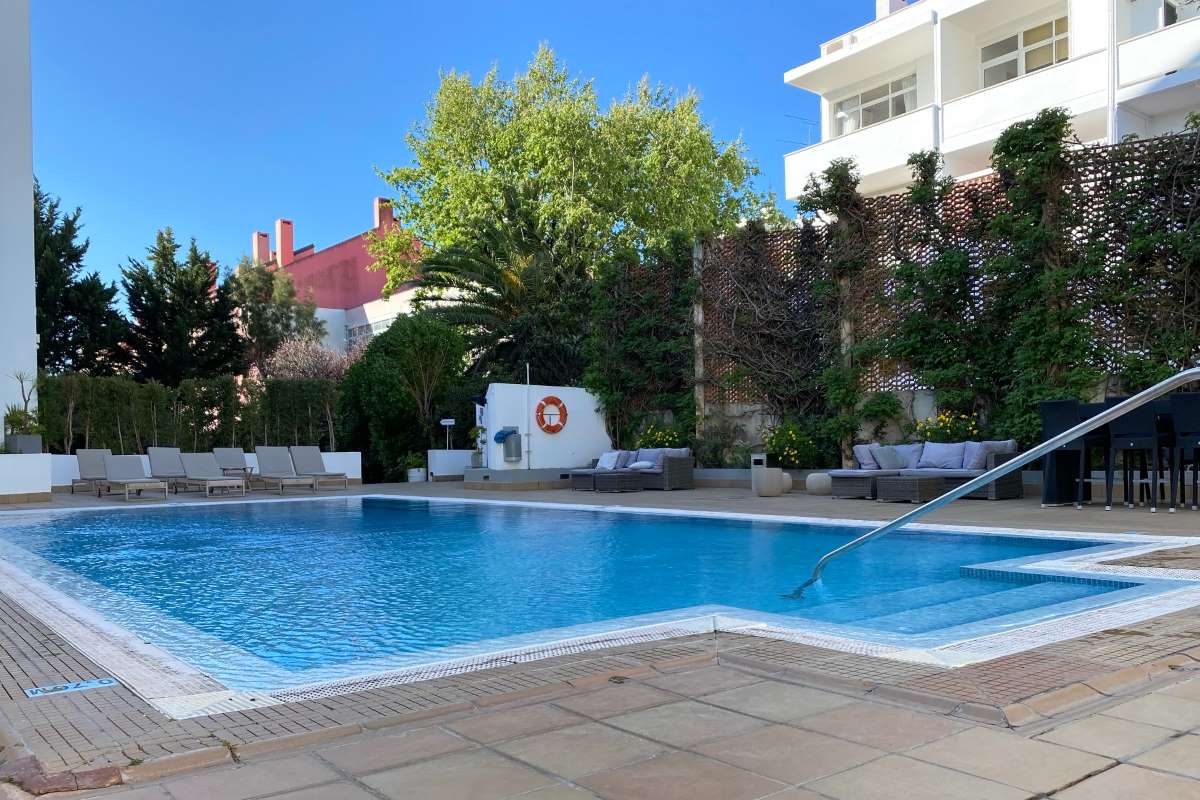 Standard residential pools like this typically fall in the $120-175/month range for weekly service.
Factors That Affect Your Price
No two pools cost the same to service. The right quote depends on size, debris, drive time, frequency, and equipment condition. If you price every account the same way, you will eventually undercharge the hard jobs and overcharge the easy ones.
Florida is a market where this shows up fast. A customer in a higher-income neighborhood may accept a quote that reflects consistent weekly service, screen maintenance, and equipment checks, while a lower-income area may force you to stay closer to the bottom of your range. The Census ACS 2024 figure of $74,568 for Florida median household income, available through the Census profile for Florida, is useful context, but the quote still has to reflect the actual pool in front of you.
Pool Size
Pool size is the biggest pricing factor because it affects chemistry, cleaning time, and overall labor. A 10,000-gallon pool takes less effort than a 30,000-gallon pool.
- Small (under 15,000 gallons): Base rate
- Medium (15,000–25,000 gallons): Base rate + $15–30/month
- Large (25,000+ gallons): Base rate + $30–60/month
If you do not know the gallon estimate, use dimensions. A 12x24 foot pool is roughly 10,000–13,000 gallons. A 16x32 is around 18,000–20,000. A 20x40 is often 24,000–30,000.
Size matters because it changes more than just chemical use. Bigger pools usually mean more surface area to skim, more water to balance, and more time spent correcting problems when the water shifts. A quote that ignores size may look competitive at first, then become a drag on your weekly schedule.
Debris Load
Tree cover and landscaping can change a pool's workload fast. A pool under oak trees or palms, or one that backs up to a golf course, will take more time than a screened pool with little debris around it.
That extra debris can add 10-20 minutes per visit. Price it in. A higher monthly rate for high-debris properties is standard because the added labor shows up every single week.
The best way to think about debris is as recurring labor, not a one-time inconvenience. If a pool fills baskets every visit, the customer is buying more than water testing. They are buying a service that keeps the pool usable despite the environment around it.
Location and Drive Time
Drive time is part of your cost. If a pool is 15 minutes outside your normal route, that creates 30 minutes of round-trip travel every week. Multiply that by a month and you are losing real time that could have gone to another account.
You have two choices. Put the customer on a route day where the stop fits naturally, or charge enough to cover the extra travel. Most pool companies add $10-25/month for pools that sit significantly off-route.
This is one of the easiest mistakes to make early on. A new customer may look profitable on paper, but if the stop breaks your route and forces extra windshield time, the account becomes expensive fast. Good pricing protects your schedule as much as your revenue.
Service Frequency
Weekly service is the standard. Some customers want biweekly visits, but biweekly pricing should not simply be half of weekly pricing.
Biweekly pools need more work per visit because debris has time to build up and water chemistry swings more between services. Chemical use per visit can also rise, and the risk of algae or cloudy water goes up between appointments.
A better rule is to price biweekly service at 60-70% of your weekly rate, not 50%. That protects you from the extra work each visit requires.
Equipment Condition
Old or poorly maintained equipment creates more work. A weak pump, clogged filter, or failing heater can turn a routine stop into a troubleshooting visit. If you spend extra time every week compensating for a problem the customer has not addressed, the price needs to reflect that reality.
This is where beginners often give away labor. They assume the equipment issue is a temporary inconvenience. In practice, it usually becomes part of the account. Either the customer repairs the equipment or the price covers the added time.
Screen Enclosures
Screened pools are easier to maintain because they collect less debris. That is why screened pools, especially in Florida and parts of Texas, often get a modest discount.
Many companies reduce the rate by $10-20/month for screened pools. That can help you win work against competitors while still keeping the account profitable. It also gives you a clear reason for why one pool is priced lower than another.
Florida pricing also tends to reflect how common screened pools are in the market. When customers already expect lower debris and easier maintenance, the screened-pool discount makes more sense to them and helps the quote feel fair. In Florida, where median household income was $74,568 in the Census ACS 2024, a clear explanation like that can make a mid-range monthly rate easier to accept. The Census profile for Florida, dated December 31, 2024, gives you a useful benchmark when you are deciding how high your market can go.
Per-Visit vs. Monthly Pricing: Which to Use
Monthly pricing is the better model for almost every pool service business. It gives you steadier revenue, simpler billing, and fewer awkward conversations about skipped visits.
| Factor | Per-Visit | Monthly |
|---|---|---|
| Revenue predictability | Variable (rain days, holidays) | Consistent |
| Customer cancellation risk | High (customers skip visits) | Low |
| Billing complexity | Need to track every visit | One recurring charge |
| Customer perception | "I'm paying every time" | "It's just a monthly service" |
| Cash flow | Lumpy | Smooth |
Per-visit pricing invites problems. Customers ask to skip service when they travel, when the weather looks bad, or when they think the pool “looks fine.” Every skipped visit costs you money and makes the pool harder to maintain the next time you show up.
Monthly pricing treats the work the way it should be treated: as an ongoing service. You service the pool on schedule, the customer pays a flat amount, and nobody has to re-negotiate every week.
How to Quote Monthly
When a prospective customer asks “how much?”, give them one monthly number.
"Based on your pool size and location, standard weekly service would be $150 per month. That includes weekly cleaning, chemical balancing, and equipment checks. I bill monthly on the 1st, and most customers set up automatic payments."
Do not lead with the per-visit equivalent unless the customer asks for it. The monthly quote sounds straightforward. The per-visit math invites them to compare your service to the cost of buying chemicals themselves, which is the wrong comparison.
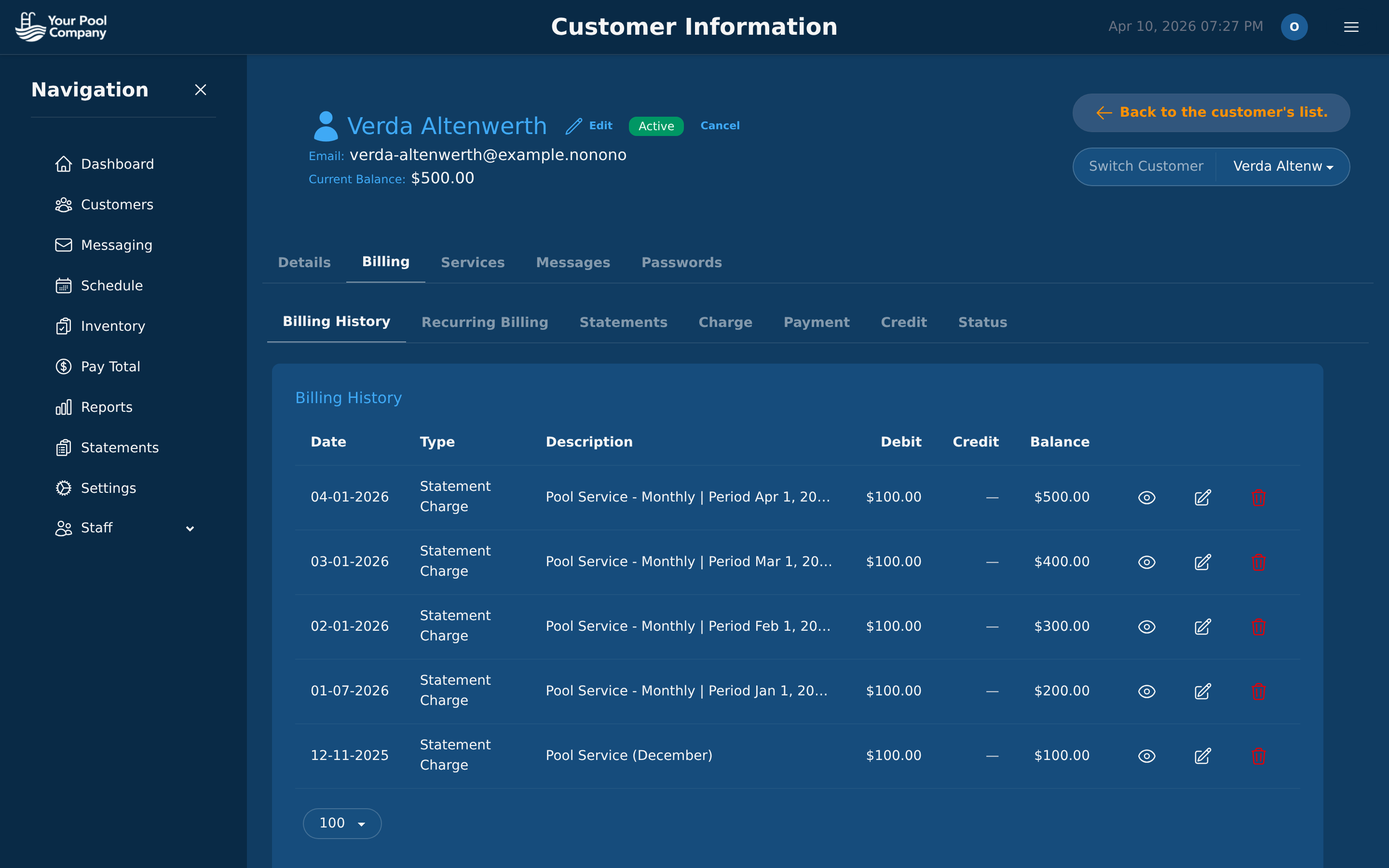 Monthly billing with automatic payments makes pricing simple for both you and the customer.
How to Quote a New Customer
A good quote starts with a site visit. The more you know about the pool before you name a price, the less likely you are to undercharge.
1. Visit the Property
Never quote a pool over the phone if you can avoid it. A “standard pool” on the phone can turn into a large lagoon-style pool with no screen and heavy tree cover.
During the visit, look at the whole account, not just the water. Note the pool size, surface type, equipment condition, debris sources, access, and drive time from your nearest stop. Surface type matters because plaster, pebble, fiberglass, and vinyl can affect how you clean and how much care the pool needs. Access matters because a locked gate, a dog, or a hard-to-reach equipment pad adds friction to every visit.
The point of the visit is not to impress the customer with technical language. It is to gather enough information to avoid pricing blind.
2. Calculate Your Base Cost
Next, estimate what each visit actually costs you. Include chemicals, drive time, service time, and overhead.
- Chemicals: $5
- 15 depending on pool size
- Drive time: Your hourly rate x the time to reach this stop
- Service time: Your hourly rate x 20-30 minutes
- Overhead share: Vehicle, insurance, software, and other operating costs
If your total cost per visit is $25 and you service the pool weekly, your monthly cost is $100 before profit. That means the quote has to go well above that number to cover overhead, profit, and a cushion for slower weeks, repairs, and mistakes.
This is the part new owners often skip. They look at chemicals alone and forget the real cost of labor and travel. A route with low chemical use can still be unprofitable if it steals too much time.
Texas utility costs can also change how quickly overhead adds up. When residential electricity sits at 16.39¢ per kilowatt-hour, as reported by the EIA in March 2026, even small equipment and office costs matter more when you are trying to protect margin across a full route.
Florida household income is another reason to check your assumptions before you quote. The Census ACS 2024 figure of $74,568 for median household income gives you a sense of what a recurring monthly rate may feel like in that market, but it does not replace the actual numbers from the property visit.
3. Apply Your Markup
A healthy recurring-service business needs room between cost and price. Many pool service companies target a 40-60% gross margin on recurring service.
If your cost is $100 per month, that usually means a charge in the $165-250 range. If your cost is $75 per month, your price might land between $125 and $185.
Where you land depends on your market, your confidence, and your competition. If you are new, pricing in the middle of the market range is often the safest move. It keeps you competitive while leaving room to raise prices after you prove reliability.
4. Present the Quote
Keep the presentation simple. Give the customer one monthly price, what it includes, and how billing works. Then send a written quote by email so they can review it and accept it.
Do not overload a new customer with multiple tiers unless you need them. One clean option is easier to sell than a menu of choices. Once the account is active, you can add filter cleans, equipment repairs, acid washes, and other services as needed.
When and How to Raise Prices
If you have not raised your prices in over a year, your margins are already shrinking. Chemical costs, fuel, labor, and insurance do not stay still.
When to Raise
Annual increases are normal. A 3-5% yearly adjustment keeps pace with rising costs, and most customers accept it.
You should also raise prices after a chemical cost spike, when your schedule fills up, or when you add more value to the service. If chlorine or other inputs rise sharply, you do not have to absorb every dollar of that increase. If your calendar is packed and you have a waitlist, your rates are likely too low. If you move from basic cleaning to full service, the price should reflect the additional work.
Florida income can also support a price review in some markets. With median household income at $74,568 in the Census ACS 2024, many Florida customers can handle a modest increase when the service is reliable and the communication is clear. That does not mean every account will stay; it means you should price against the market you actually serve, not just the number you started with.
How to Communicate a Price Increase
Give customers 30 days' written notice. Keep the message short and direct:
"Effective May 1st, your monthly service rate will increase from $145 to $155. This adjustment reflects increased chemical and operating costs. Your service schedule and included services remain the same. Thank you for your continued business."
Do not apologize for raising rates. You are running a business, and costs move in one direction more often than not. A clear notice is better than a long explanation.
Some customers will leave after a price increase, and that is normal. The accounts that leave over a modest monthly adjustment are often the most demanding ones. The customers who stay usually understand that reliable service has a cost.
 As your reputation grows and your schedule fills, your prices should grow with it.
Track Your Pricing with Software
As your customer count grows, pricing gets harder to manage by hand. Different rates, different billing dates, and different price increases create room for mistakes.
Pool service software with built-in billing solves that problem. With EZ Pool Biller, each customer can have a subscription with a specific rate, billing frequency, and payment method. When you raise prices, you update the subscription and the system handles the rest.
That means less spreadsheet cleanup, fewer missed increases, and fewer billing errors. It also gives you a better view of which accounts are profitable and which ones need a rate adjustment. Pool service software also helps you keep routing, chemical tracking, reports, payroll, QuickBooks integration, and the customer portal tied to the same customer record instead of scattered across separate tools.
Next Steps
Initial pricing is only the starting point. As your business grows, you will refine your approach with tiered service packages, volume pricing for multi-property customers, seasonal rate adjustments, and one-time services like green-to-clean work, acid washes, and filter replacement.
For a deeper look at those strategies, read our Pool Service Pricing Strategy: Complete Guide.
When you are ready to automate billing so price changes, invoicing, and payment collection happen without manual work, start a free trial with EZ Pool Biller. Plans start at $35/month — see full pricing.
Frequently Asked Questions
How do I choose between monthly pricing and per-visit pricing for pool service? Monthly pricing works best when you want predictable recurring revenue and a clearer way to compare service levels. Per-visit pricing can be useful for older accounts or when you need to translate a weekly quote into a visit-based rate. If you use either model, make sure the price still reflects what each pool costs you to service.
What factors should I consider before setting my rates? Your rates should be based on market awareness, route planning, and a solid understanding of service costs. Competition and local demand matter a lot, since some markets price lower because there are more providers and others price higher because there are fewer. You also need to think about what each service level includes, from chemical balancing to equipment maintenance.
How should I quote a new pool service account without underpricing it? Start by matching the customer’s needs to the appropriate service level, then price from there instead of guessing. A chemical-only account should not be priced like a full-service account because the labor and responsibilities are very different. The goal is to cover your costs, account for route efficiency, and leave room for a healthy margin.
When is it time to raise pool service prices? Raise prices when your current rates no longer reflect your costs, your workload, or the value of the service level you provide. If you find yourself working long weeks for thin margins, your pricing is probably too low. Price increases are also appropriate when your market changes or when an account requires more than it did when you first quoted it.