
Key Takeaway: Pool service taxes stay manageable when you know where sales tax applies, how your business structure affects income tax, and which records you need to keep. Complete pool service management software makes filing simpler, reduces missed deductions, and keeps you ready for an audit.
Taxes are part of running a pool service business, and mistakes get expensive fast. Missed sales tax, weak record keeping, or an unexpected tax bill can wipe out profit from a strong month. The right approach is direct: know whether your state taxes the work you do, understand how your business is taxed, keep clean records, and use software that captures the numbers as you go.
Tax rules also connect to the work itself. The CDC documented recreational-water-illness outbreaks in its healthy swimming guidance dated December 31, 2019. That is the downside pool owners and operators want to avoid, and it is also a reminder that consistent service, chemical tracking, and documentation belong in the same system as billing and taxes. If your records show steady service and clean chemical logs, you build a clearer business trail for tax time too.
For owners planning growth or a future sale, financing can shape the tax picture as well. The SBA’s 7(a) loan program continues to support small-business acquisitions across service industries, based on its June 1, 2026 program page. That matters when a pool route purchase, expansion, or succession plan brings debt into the business. The tax treatment of interest, payments, and acquired assets can change what the deal really costs.
A good tax system also protects you from problems that start small and become expensive later. Suppose a route day includes a taxable service stop, a supply purchase, and a payment collected at the truck. If those details live in three different places, someone has to reconstruct the month line by line when the accountant asks for support. When the same information sits in one system, the statement history, chemical logs, and payment records tell the story without guesswork. That is the difference between filing from facts and filing from memory.
The same documentation that helps with tax filing also improves day-to-day discipline. When a business can show where service happened, what chemicals were used, and how charges were recorded, it becomes easier to defend the numbers if a question comes up later. Tax prep and operations should run through the same system.
Here is a simple example. An owner with a tight route stops at one account that is taxable, then another that is exempt, then swings by a supplier for chemicals on the way back. If that day is tracked in a notebook or spread across texts, receipts, and memory, month-end cleanup turns into detective work. When the same route lives inside billing and service software, the charge, tax rule, and supply expense are tied to the job from the start. That saves time and keeps the numbers consistent when the accountant reviews the books.
Do Pool Services Owe Sales Tax?
Sales tax is one of the first questions pool service owners need to answer, and the answer depends on state rules. Pool service is treated differently across jurisdictions, so you need to know whether your work is taxable where you operate and how your state classifies the service you provide.
The type of work matters as much as the location. A maintenance visit, a repair, and a product sale may not follow the same rule. The safest approach is to document each charge clearly and let your billing system do the heavy lifting.
States That Tax Pool Service
In many states, pool cleaning and maintenance is a taxable service. If that applies to your business, you need to collect sales tax from customers on each service visit, remit it to the state tax authority on the required schedule, and track the tax separately from your revenue.
That separation matters. Sales tax is not income. It is money you collected on behalf of the state, so it should never blend into your operating revenue. If you treat it as income by mistake, your books become misleading and your filing gets harder.
States That Don't Tax Pool Service
Some states do not tax services broadly, and others exempt pool maintenance specifically. The exact treatment often depends on whether the work is considered repair or maintenance. That distinction can matter a lot. A repair may be taxable in one jurisdiction while routine maintenance is exempt in another, even when the job looks similar from the customer’s perspective.
Because state rules differ, verify your own state’s treatment of pool service instead of assuming the rule from a neighboring state applies to you. A quick review with a tax professional can prevent a costly filing mistake later.
How to Handle Sales Tax in Your Billing
Your billing software should make sales tax easy to apply and easy to report. At a minimum, it should support configurable tax rates by jurisdiction, tax calculated on each charge, and reporting that shows how much tax you collected during a given period.
That matters for pool service businesses that work across cities or counties with different tax rules. If your service area spans multiple jurisdictions, a flat manual approach creates problems quickly. One customer may be taxed at one rate while another should be taxed differently. Software handles that pattern more reliably than a spreadsheet or a manual statement process.
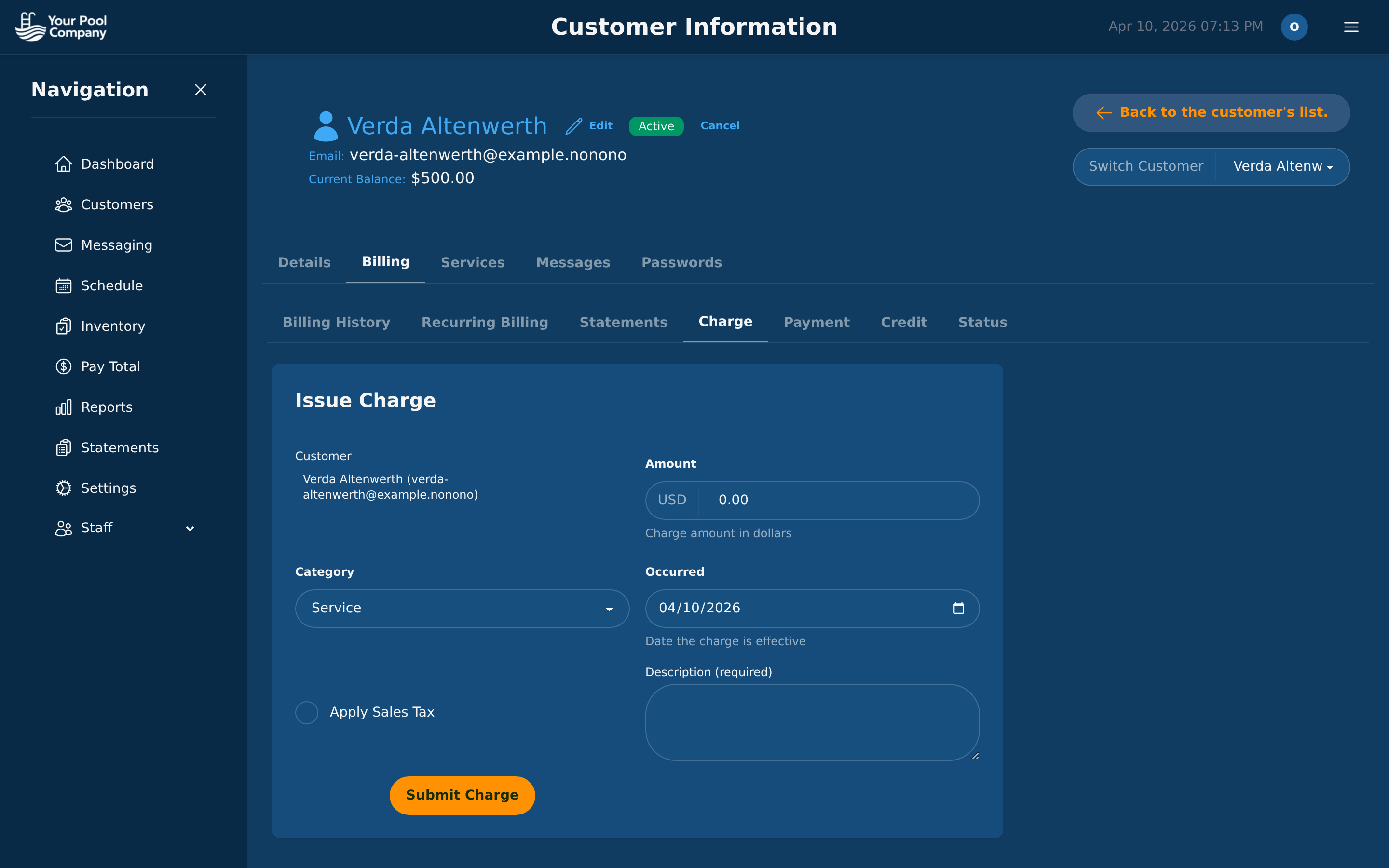 The charge form includes an "Apply Sales Tax" toggle with a configurable rate. Tax is calculated automatically on the charge amount.
A route exposes the risk fast. A technician may start the morning in one city, finish the afternoon in another, and collect payment at the end of the day. If one stop is taxable and the next is not, a hand-built statement depends on memory. The office has to remember the city, the tax rule, and the right amount every time. When that same charge runs through software, the statement reflects the correct tax the first time, and the records match the work that actually happened. One missed tax treatment on a busy route can turn into hours of correction at month-end. That is the difference between a system that supports filing and one that creates cleanup work later.
A concrete example makes the point clearer. A technician services two accounts in different cities on the same route day. One city taxes pool maintenance, while the other exempts it. If the office builds statements by hand, it is easy to apply the wrong tax to one stop or forget it altogether. If billing lives inside the service workflow, the charge follows the job, the tax rule follows the location, and the statement stays accurate without a second pass. That saves time at the desk and reduces the chance of a state notice later.
That is why tax handling should live inside your billing workflow, not in a separate spreadsheet. When billing, service notes, and tax reporting line up, you reduce errors and make the books easier to trust.
Income Tax for Pool Service Businesses
Sales tax is only one part of the picture. Income tax affects the profit your business keeps, and how that tax is handled depends on how you structure the company. The structure you choose changes what gets reported on your return, how much self-employment tax you owe, and whether payroll comes into play.
That is where bookkeeping discipline starts to pay off. When service revenue, chemicals, and route activity are tracked cleanly, your tax picture is easier to read and easier to defend. Better records do not just help at filing time. They help you make better structure decisions during the year.
Business Structure Matters
Your tax obligations depend on your business structure:
| Structure | How You're Taxed |
|---|---|
| Sole Proprietorship | Business income reported on your personal tax return (Schedule C) |
| LLC (single member) | Same as sole proprietorship unless you elect S-Corp |
| LLC (S-Corp election) | Pay yourself a reasonable salary; remaining profits pass through with lower self-employment tax |
| S-Corporation | Salary + distributions. Requires payroll for yourself |
Most solo pool service operators begin as sole proprietors or single-member LLCs because the setup is simple. That can work well in the early stage of a business. As profit grows and the tax burden becomes more meaningful, it is worth asking whether an S-Corp election would lower self-employment tax enough to justify the added payroll and compliance work.
The right time to explore that change is not based on a slogan or a rule of thumb copied from someone else. It depends on profit, payroll needs, and how disciplined you are about record keeping. If your business is consistently producing solid profit and you are paying yourself regularly, a tax professional can help you compare the options.
Estimated Quarterly Payments
Unlike employee wages, business income usually does not have taxes withheld automatically. That is why estimated quarterly payments exist. They help you pay income tax throughout the year instead of facing one large bill at filing time.
The payment schedule is straightforward:
- Q1: April 15
- Q2: June 15
- Q3: September 15
- Q4: January 15
Missing these deadlines can lead to penalties, especially if your income rises during the season and you do not adjust your estimates. A practical habit is to set aside a portion of every payment you collect and move it into a separate tax savings account. Many owners use a range of 25-30% of net profit as a simple discipline, then refine it with the help of an accountant based on their actual tax rate and business structure.
That habit helps in another way too: it keeps cash flow honest. If tax money stays mixed with operating cash, it becomes too easy to spend it on fuel, chemicals, or payroll and hope to catch up later. Separate accounts reduce that risk.
Tax Deductions for Pool Service Companies
Deductions are where careful record keeping pays off. Every legitimate business expense reduces taxable income, and pool service businesses usually have several categories of deductible costs. The key is not just knowing what qualifies, but tracking it in a way that stands up when tax time arrives.
The CDC’s outbreak data also reinforces why chemical and supply logs matter. Clean water is part of the job, and the same records that support better operations can support cleaner tax reporting. When the business can show what it bought, when it bought it, and how it used those supplies, the deduction is easier to support.
Vehicle Expenses
Your truck or van is often one of your largest deductions. You can deduct vehicle costs in one of two ways. The standard mileage rate lets you deduct a set amount per business mile, and the actual expense method lets you deduct the business-use portion of costs such as gas, insurance, maintenance, and depreciation.
The choice depends on your numbers and your record keeping. Mileage is simple if you drive a lot of service routes and want a clean method. Actual expenses can work well if the vehicle is expensive to operate or you want to capture a larger share of the cost. Either way, the IRS expects documentation, not estimates pulled together at year-end.
A mileage log is not optional in practice. You need a record of where you went, when you went there, and why the trip was business-related. Apps like MileIQ can help, and route tracking inside your pool service software can also serve as supporting documentation when it clearly shows the workday travel associated with customer service.
Chemicals and Supplies
Chemical and supply costs are part of the core operation of a pool service business, and they are deductible business expenses. That includes chlorine, acid, soda ash, calcium, stabilizer, test kits, reagents, filters, gaskets, O-rings, skimmer baskets, pump parts, and the cleaning tools you use every day.
This is one of the easiest categories to miss if your receipts are scattered across hardware stores, supply houses, and online orders. The expense is real, but the deduction only helps if you can show what you bought and connect it to the business. Keeping supply purchases organized by month gives you a much clearer year-end picture.
Equipment
Pool service tools such as poles, nets, brushes, and vacuums are deductible, as are power tools and other business equipment. If you supply replacement equipment for customers, that cost can also be part of your deductions.
For larger purchases, Section 179 can be especially useful because it may allow you to deduct the full cost of qualifying equipment in the year you buy it instead of spreading the deduction over time. That can make a real difference when you are replacing major tools or making the business more efficient. The right approach depends on your overall tax picture, so it is worth discussing before you make a large purchase near year-end.
Insurance
Insurance is another straightforward deduction category. General liability insurance, commercial auto insurance, workers' compensation if you have employees, and bonding if your state requires it are all business costs tied directly to operations.
These premiums do more than protect you from risk. They also support your tax record by showing that the business is operating as a real service company with real overhead, not as a casual side job. Keep the policy documents and payment records with your other business records so the numbers are easy to trace.
Software and Technology
Software is one of the most overlooked deductions in a pool service business, even though it touches nearly every job. Pool service management software, accounting software, a business phone, business-use percentage of a phone plan, and payment processing fees can all be deducted when they are ordinary and necessary business expenses.
EZ Pool Biller fits that category as complete pool service management software, not just a billing tool. It covers billing, routing, chemical tracking, a mobile app, reports, payroll, QuickBooks integration, and a customer portal. If you are using software to run the business, keep the subscription and fee records. A clean digital trail is easier to defend than a stack of loose receipts.
Payment processing fees are especially easy to overlook because they come off deposits automatically. But fees from Stripe, PayPal, and similar processors are a real business expense and should be recorded that way.
Other Common Deductions
Several other expenses often qualify as deductions, and they are easy to miss when you are focused on day-to-day service work. A home office can qualify if you genuinely run the business from home and meet the IRS requirements. Uniforms and company apparel, marketing and advertising, professional development such as CPO courses, business meals when they are tied to a real client or business meeting, bank fees, interest on business loans, and accountant or bookkeeper fees can also be deductible.
The pattern is simple: if the expense helps the business operate, grow, or stay compliant, it may belong on your tax return. The challenge is not imagination. It is documentation. Every category needs the paper trail to match the deduction.
Including Tax on Your Statements
A statement should make sales tax obvious. Customers should be able to see the service charge, the tax amount, and the total without guessing how the final number was built. That clarity helps you, too, because it keeps tax money separate from revenue and makes filing easier later.
A simple statement format looks like this:
Pool Service - Monthly (Standard)     $150.00
Sales Tax (7%)                         $10.50
─────────────────────────────────────────────
Total                                 $160.50
Do not bury tax inside your service price. If you bundle it into a flat number, the customer cannot see how much is service and how much is tax, and your accounting becomes harder to reconcile. Separate tax lines also reduce confusion when a customer compares statements from month to month or asks why the total changed.
Your billing software should handle this automatically. Set the tax rate once, make sure the correct jurisdiction is assigned, and let the statement calculate tax every time the charge is created. That saves time, reduces errors, and keeps each statement consistent.
Record Keeping
Good records are the difference between a smooth filing season and a stressful scramble. They also matter if the IRS or your state asks for proof. The more organized your records are during the year, the less time you spend trying to reconstruct them later.
Clean records matter for a different reason, too: they show the business is operating like a real company. When statements, routes, chemicals, and payments line up, your tax trail is easier to follow from start to finish.
What to Keep
You should keep all statements, all receipts, bank and credit card statements, mileage logs, payroll records if you have employees, and tax filings. In practice, that means every charge, every supply purchase, every deposit, and every expense should be traceable.
Keep tax filings for at least seven years. That gives you a solid archive if you need to revisit a return, answer a question from a tax authority, or verify a prior-year deduction. For pool service businesses, the strongest records are the ones that connect the work you did in the field with the money that moved through the business.
How Software Helps
Pool service software that integrates with QuickBooks makes record keeping much easier. It can export statements automatically, match payment records to statements, generate revenue reports by period for tax filing, and track chemical costs that support supply deductions.
That integration matters because tax filing is not just about totals. It is about consistency. If your billing software, route data, and accounting records all tell the same story, you spend less time cleaning up mismatches and more time running the business.
See how EZ Pool Biller syncs with QuickBooks →
Common Tax Mistakes
Most tax problems in pool service businesses come from simple process failures, not exotic rules. The same mistakes show up again and again: taxes not collected, expenses mixed, receipts missing, and filings skipped. The fix is to build a routine before those issues compound.
Rather than treating tax work as a year-end rescue job, treat it as part of the weekly operating rhythm. When the office closes each day with accurate statements and the field updates are already captured, the month-end review gets easier. That discipline matters in the real world. A one-van operator can lose a full afternoon trying to sort out a stack of faded fuel receipts, missed supply purchases, and a statement where sales tax was never applied. When the same operator uses software and keeps business spending separate, the accountant gets clean records instead of a puzzle.
- Not collecting sales tax when required — this creates a surprise liability when the state catches up
- Mixing personal and business expenses — use a separate business bank account and credit card
- Not making estimated payments — penalties accumulate quarterly
- Missing deductions — especially vehicle expenses and home office. These are the biggest missed deductions for service businesses
- Not keeping receipts — "I think I spent about..." doesn't hold up in an audit
- Paying cash to workers without reporting — this is illegal and creates liability for both you and the worker
- Forgetting to file state returns — federal isn't the only filing. State and sometimes local returns are also required
The common thread is weak systems. When tax tracking depends on memory, the business becomes vulnerable to missed filings and unrecoverable expenses. When the systems are built into billing, accounting, and payroll, tax season becomes a review process instead of a rescue mission.
When to Hire an Accountant
There is a point where handling taxes alone stops saving money and starts costing it. Once your revenue grows, payroll enters the picture, or you start expanding beyond one service area, an accountant can help you avoid mistakes that are expensive to unwind.
You should hire a tax professional when your revenue exceeds $50,000 per year, you have employees, you are considering a change in business structure, you have been audited or received a notice, or you are expanding into new states or jurisdictions. Each of those situations adds complexity, and complexity is where professional guidance pays for itself.
A good accountant does more than file forms. They can help you choose the right structure, identify deductions you may be missing, and keep you from overpaying or underpaying tax. For a small service business, expect roughly $500-2,000 per year, depending on the scope of the work and the complexity of the return. That cost can be easier to justify when the accountant helps prevent penalties or recover deductions that would otherwise be missed.
Year-End Tax Checklist
Year-end is the right time to clean up the numbers while the year is still fresh. A structured checklist keeps you from carrying messy records into the new year and helps you make better decisions before December 31.
- Reconcile all bank and credit card statements
- Export revenue reports from billing software
- Calculate total mileage for the year
- Gather all receipts for chemicals, equipment, and supplies
- Review payroll records (if applicable)
- Calculate estimated tax for Q4 payment
- Meet with accountant before December 31 for year-end planning
- Make any last equipment purchases that qualify for Section 179
The point of this checklist is not just compliance. It is control. When you close the books carefully, you start the next year with cleaner numbers, clearer tax planning, and fewer surprises.
This guide is for informational purposes. Tax rules vary by jurisdiction and change frequently. Consult a licensed tax professional for advice specific to your situation.
Start your free trial → — EZ Pool Biller tracks your revenue, chemical costs, and generates the reports your accountant needs.
Frequently Asked Questions
How do I know whether I should charge sales tax on pool service jobs?
You need to check how your state classifies the work you perform, because pool service is taxed differently across jurisdictions. In many states, cleaning and maintenance are taxable, while some states do not tax services broadly or exempt pool maintenance specifically. The key distinction is often whether the
Related: Financial Metrics Every Pool Service Owner Should Know
Related: Strategic Business Analysis Tools Every Pool Owner Should Use
Related: [Related:
Related: [Related: [Related: [Related: [Related: [Related: [Related: Top Remote Management Trends Every Pool Service Pro Should Know
Related: Top Seasonal Adjustments Trends Every Pool Service Pro Should Know